That wonderful (anonymous) comment from the last post made a good point. I'm one who celebrates his entire discography, although there are some real clunkers on his lesser albums.
Anyway, this revised list is for the people who might run away screaming from their stereo systems the moment they hear Uncle Meat. I need to keep in mind, what I consider Zappa's masterpieces just aren't for everyone.
Let's do round two, in which FZ's more accessible material is the focus:
10. Freak Out! (1966)
The last twenty minutes of this hour-long double album notwithstanding, this is a good, healthy blast of the mid-60's LA scene along with some finely-written pop songs...and a greasy doo-wop number that firmly established that often-repeated phrase from the LP's gatefold, "No Commercial Potential."
Oh, how we beg to differ.
Key tracks: "Hungry Freaks, Daddy," "Who Are The Brain Police?," "Motherly Love," "Wowie Zowie," "Trouble Every Day"
09. Joe's Garage (1979)
One of the best fusions of orchestral sensibilities with rock and roll instruments, this album has some of Zappa's most memorable (and quotable) moments. Peppered throughout are some amazing guitar solos, proof that Ike Willis is the most underrated singer in rock and roll, and some of Zappa's most beautiful (and haunting) melodies.
The only caveat is there's plenty of crude humor that might throw off an average listener with tales mocking religion, depictions of sex in German (later described in English - may want to brace yourself for that one), and incredibly unsubtle mentions of, uh...prison romance. Don't play this for your girlfriend if she's Catholic.
Definitely play this for your girlfriend if she's a lapsed Catholic.
Key tracks: "Catholic Girls," "Why Does It Hurt When I Pee?," "Lucille Has Messed My Mind Up," "A Token Of My Extreme," "Watermelon In Easter Hay"
08. The Grand Wazoo (1972)
I was a bit reluctant to have two jazz records on here, but this one is too damn good to pass up. Featuring a true big band, rather than the usual shit-ton of overdubbage from someone like Ian Underwood or Sal Marquez (although Marquez is very much on this record, in full trumpeting force), the album's title track wouldn't be out of place in some sort of historical epic. And George Duke's hot-shit keyboard solo on "Eat That Question" and its lead-in to one of Zappa's funkiest grooves is not to be missed.
The only thing that might throw off the "average" listener (whoever that might be) is the absence of lyrics. There really is sort of a demand, as Zappa pointed out with typical cynicism, that songs have words in the present day. Regardless, this is a great introduction for the jazz-head.
Key tracks: "The Grand Wazoo," "For Calvin (And His Next Two Hitchhikers)," "Cletus Awreetus-Awrightus," "Eat That Question," "Blessed Relief" (The whole album is five tracks...they're all great.)
07. Sheik Yerbouti (1979)
No libretto, no maniacal sonic experiments, no stage antics, just rock and roll - Zappa style, of course. This is the album for the "classic rock" fan. Terry Bozzio's vocal adventures, Adrian Belew's Dylan imitation (by the way, Adrian Belew is on this album), and the seamless dubbing of studio material onto live backing tracks make for one Hell of a trip.
The only real hang-up here is the song that caused some trouble for FZ back then: "Jewish Princess." Justify it all you want, give them the great Zappa quote of "Unlike the unicorn, the Jewish Princess does indeed exist in our society," explain that he wasn't a misogynist, and you might still have a very indignant reaction.
Don't play this album for your rabbi.
Key tracks: "Flakes," "Tryin' To Grow A Chin," "City Of Tiny Lites," "Dancin' Fool," "Wild Love"
06. Over-Nite Sensation (1973)
The debut of The Mothers mark III, this is a compact run of pop/rock/jazz numbers that shows off the incredible talents of Jean-Luc Ponty, George Duke, and Ruth Underwood. The real star here, though, is Frank, having lead vocals on nearly all of the songs (with MVP going to in-and-out-of-Zappa's-band-because-of-alcohol vocalist Ricky Lancelotti for his two madcap performances) and providing a great guitar solo - short or long - on EVERY tune.
The only snag? "Dinah-Moe Humm" plays like a porno. You can't hide behind hoping the listener will focus only on the music; the song is mixed in such a way that the vocals are pretty front-and-center.
Also, and this is my own hang-up, but I personally think "Montana" is one of his stupidest songs. Period.
Key tracks: "Camarillo Brillo," "I'm The Slime," "Dirty Love," "Fifty-Fifty," "Dinah-Moe Humm"
05. Hot Rats (1969)
Rykodisc nailed it when they referred to this album as "the album that people who don't even like Frank Zappa can enjoy" (or something to that effect). Possessing a distinctly rockier/bluesier edge than The Grand Wazoo, this really is one of the best all-around introductions to Zappa as a songwriter.
Key tracks: "Peaches En Regalia," "Willie The Pimp," "The Gumbo Variations"
04. Apostrophe (') (1974)
This is one of the easiest FZ albums to hunt down used on vinyl. It's just one of those mid-70's albums it seemed everyone owned, no doubt because of "Don't Eat The Yellow Snow." Unlike, say, "Valley Girl" and Ship Arriving Too Late To Save A Drowning Witch, it's not hard to picture buyers giving equal time to both sides of this record.
Key tracks: The "Don't Eat The Yellow Snow" suite on Side A, "Cosmik Debris," "Apostrophe (')," "Uncle Remus" (I actually know two people who have done as the lyrics to this song describe: stealing lawn jockeys out of rich people's lawns. One I don't think knew Zappa...in fact, they took the jockey and shot it with a Mosin Nagant rifle...the other guy did it because of this song.)
03. We're Only In It For The Money (1968)
Quintessential Zappa, with what many consider his best band (if just on principle - and with said principle in mind, they kind of were) and an even smaller contingency feel is his only band worth a good God-damn. Plenty of humor, bold musical experiments, and even a dash of pathos here and there.
Not to be played for hippies.
Key tracks: "Who Needs The Peace Corps?," "Mom And Dad," "Flower Punk," "The Idiot Bastard Son," "Mother People"
02. You Are What You Is (1981)
There's some bias in this. I love this album, and I contend it is Zappa's most accessible album in the milieu of pop-rock. The lyrical topics were life-altering (side C's series of songs on religion said things I'd been thinking for years by age 15) and just plain funny, sending up the shallower side of American society. Great vocal performances throughout courtesy of Bob Harris, Ray White, Ike Willis, and even the Indian of the Group himself, Mr. Jimmy Carl Black.
Frank's sneering vocal line on "Dumb All Over" sounds like he's on the brink of spewing acid. Unforgettably awesome.
Might want to skip the song where the protagonist smacks his (whiny, obnoxious shrew of a) girlfriend, though.
Key tracks: "Teenage Wind," "Harder Than Your Husband," "Doreen," "The Meek Shall Inherit Nothing," "Dumb All Over"
01. One Size Fits All (1975)
I reviewed this one back in the summer of 2009, so you can read all about it there. It is the album I consider the finest example of Zappa's "Zappaesque" sound, with goofy lyrics that conceal two or three different layers of meaning, mean guitar work, and musicianship that will make you wonder why you're even bothering with your garage band.
Key tracks: "Inca Roads," "Can't Afford No Shoes," "Sofa #1," "San Ber'dino," "Andy"
Showing posts with label Frank Zappa. Show all posts
Showing posts with label Frank Zappa. Show all posts
Thursday, February 25, 2010

Tuesday, February 23, 2010
So, You Want To Get Into.........Frank Zappa?
Have I talked about this before, the AV Club's feature called "Gateways To Geekery?" It's one of the best columns they have, though I feel like they don't do it enough. There's plenty out there that seems daunting at least from the outset.
Anyway, this is the same premise - and be real, this might be an act of theft, but their own column is an act of theft of the type of conversations you would have with your friends ("I've always wanted to get into so-and-so, any suggestions on where to start?"), so don't even start - as the AV Club's column, making allowances for my own opinions. I really need to branch out from just music. In fact, since I still think my Dr. No review stands as proof that I'm reeeeeeally rusty at writing about films, it might be better for me to frame films through such a context - "So, You Want To Get Into.........Monty Python?" or "...Soviet Film?" would be good entries.
Let's start.
I'm a Zappa fan who is sort of on the fence about fellow Zappa fans. The ones I meet in person I get along with really well. I was telling a friend this past weekend it's a lot like meeting a fellow drummer, in that we can talk for hours about "What was your first FZ album?" or "Who's your favorite bassist?", fun stuff like that.
The online fan community, though? Rabid, contrary, bloviating, arrogant, misinformed, close-minded, vitriolic, territorial, and confrontational. There are some shining stars out there. My friends running Kill Ugly Radio are great. It's in the comment boards, however, that the discourse can veer into some unappetizing turf. Some of these bozos can't comprehend first of all that Frank Zappa was not only human, but one with many character flaws.
Second, anyone who doesn't appreciate one of his works is an uncultured Philistine who simply "doesn't get it." This especially becomes the constant cop-out in instances where Uncle Frank gets exceptionally vulgar. To them, if you find his work offensive, it has something to do with YOU, not the music.
Take my dad - a very open-minded guy musically, with everything from Beethoven to Juice Newton to Cheap Trick to Indian folk music in his collection. But for the most part, he doesn't like Frank Zappa, and it isn't a case of him not "getting it." Believe me, in all my attempts to proselytize to him I have had success in all other cases (I got him into The Ramones, The Residents, Wesley Willis, and pretty much any original blues rendition of a song later done by Cream or The Yardbirds), but with Zappa's discography it's almost completely been a brick wall. One notable exception was this past January when we listened to Orchestral Favorites in the car. He said it was "not bad," which on his grading scale is about a B.*
Trust me, he "got it" when he heard "Dinah-Moe Humm." He "got it" when Flo and Eddie sang about monstrous dicks on Fillmore East, June 1971. He "got it" when he heard this stuff originally, and he "got it" 30 years later when I tried playing it for him.
His criticisms are three simple, admittedly valid points:
1.) "He Just Tries Too Hard To Be Weird!"
This is where it simply becomes a matter of taste. Some chords, timbres, tones, and intervals that may seem harsh to one set of ears could very well be another person's conception of what Heaven itself sounds like. My dad didn't care for Uncle Meat, he said it was "harsh and atonal."
And you know what? He's right. That's also the exact same reason I LOVE that album.
2.) "He Can Be Too Vulgar Sometimes!"
Since Zappa regularly singled out Republicans (though he did target Democratic figures on occasion, too), it's a safe bet that just about any serious analyst of Zappa's work is at least slightly left of center. Unfortunately, this means more than a few of them (Kelly Fisher Lowe's The Words & Music of Frank Zappa does this to the point of annoyance) attempt to justify the existence of songs in Zappa's canon that contain references to bodily functions, sex, sexism, racism, and homophobia. Frank was no racist - his earliest bands featured black and Chicano musicians, before The Mothers Of Invention - and he was certainly no sexist. But he was fascinated by gender roles. He was fascinated by human nature. And guess what? Humans do some pretty interesting things. Put into an unflinchingly honest light, they can seem disgusting. They can even seem alien.
This is the thrust of so much of his "vulgar" works.
Ben Watson upped the ante with the claim that Zappa's trips to Vulgaria are a test on the listener's values. Things are only offensive because of one's own morals. Blah, blah, blah. It's all horse-shit. You know how some people (maybe even you, the reader) just can NOT talk about bowel movements? Yet others - myself included - can be pretty shameless in talking about our latest dump? It's not that the people - mainly women - who jokingly deny that they even create poo are close-minded moralists. They just think it's nasty.
Again, yes, poop is nasty. But it's something we all do...and, as before, it's a matter of taste, BUT - poop can be very, very funny. (Note to self: try to avoid having the words "poop" and "taste" in the same sentence.)
Zappa could be pretty vulgar, sometimes without using a single proper swear word. In fact, those are sometimes the worst (uh, "Keep It Greasey," anyone?). Same case can be made - how comfortable you are with such crudity is a tricky and highly subjective case.
3.) "God, That Guy Could Be A Cynical Asshole!"
Zappa wasn't exactly Mr. Sunshine, even when he was younger and slightly idealistic. For most of his career, I'd say he was a blunt realist. It is not an attitude everyone can appreciate, and I understand that. After about 1980, Frank got increasingly cynical - and I wager even bitter - regarding the declining state of affairs in the world of popular music, the world of "serious" music, and the United States. His dislike of punk music, baseless accusations of conspiracies levied on the American public, and the future of music make him come off like a cranky curmudgeon.
That said, there is a point where I think Zappa's music has to be separated from Zappa the human, otherwise you'll find it very hard to listen to Broadway The Hard Way without thinking of his dissolution of what would be his final band, or to hear any of his Synclavier albums without thinking of his claim that if he'd had a Synclavier in the 60's he never would have had a band.
So, where to start indeed? He released almost 60 albums during his life. Sixty. The guy put out more albums than years he walked this planet. With similarly long-lived groups like The Kinks or The Rolling Stones, you can point to maybe five releases that are absolute essentials. But again, their discography is roughly a third of the size of Zappa's. As a result, I'd say a core collection of Zappa albums would number maybe 10. Keep in mind, though, that the following lists are based on even representation of his multifaceted career. Some - not all, mind you - of my personal favorites might have seeped through onto this list, but (I assure you) not because of any bias.
The Core Collection:
01. Freak Out! (1966)
Remember everything I said about all those British Invasion debut albums? This is just the opposite. It's bold - oh, so bold - with lyrical put-downs of the authorities, education, love, the Watts riots, and close-minded conservatism. The song also has some catchy (in some instances, I think cloying) pop songs thrown in for good measure, with some incredibly bizarre avant-garde pieces to round out this 2-LP set. There's some great rock and roll, some surprising pop music, and experimental tunes you could use to frighten your grandparents.
In short, Zappa needed four sides of vinyl to introduce himself to the world. I don't think it's one of his best, but dammit if it doesn't prove he was incredibly ambitious (and talented as a songwriter/composer) from the very start.
Key tracks: "Hungry Freaks, Daddy," "Who Are The Brain Police?," "Wowie Zowie," "Trouble Every Day," "The Return Of The Son Of Monster Magnet"
02. We're Only In It For The Money (1968)
If you were to only get one Frank Zappa album, it is this one. Recorded in the wake of the Summer of Love, Zappa calls out the hippie movement as one that had been taken over by kids equating freedom with free weed and free tail as well as the record companies hoping to turn the music of the counterculture into something. Some of it gets even darker, suggesting a Kafkaesque nightmare where hippies would be rounded up and placed in internment camps and warnings of a murderous police state.
What was blasphemous to some and a nod-inducing manifesto to others then is a fine case of iconoclasm effectively calling the bluff of an entire generation that collapsed into itself like a dying star in a haze of self-importance. The Age of Aquarius would never come, frankly because the entire notion was bunk from the get-go. Frank was the one in the 1960's who was urging people to join the system if just to infiltrate it from the inside out. They could have listened...but the LSD and the titties were just too damn tempting.
All of this lyrical bluntness is set to an amazing sonic backdrop of rock, gorgeously illustrated with some fantastic performances by The Mothers Of Invention. There's also some extremely discomforting pieces of musique concrete...those with an aversion to harsh noise: avoid the album's closing track like the plague. (I think it's a masterpiece.)
Key tracks: "Who Needs The Peace Corps?," "Mom And Dad," "Flower Punk," "Mother People," "The Chrome-Plated Megaphone Of Destiny"
03. Uncle Meat (1969)
Another double album, this features Zappa using The Mothers in lieu of an orchestra by way of layering tracks upon tracks. The music has gotten more dense and complex, and the album itself marks the debut of many of Zappa's musical staples: tuned percussion, deliberately harsh editing between songs, and a monster jam on side D. The shifts between blues vamps, avant-jazz, chamber pieces, surrealistic tunes with gorgeous melodies, and field recordings might be jarring, but this sort of manic juxtaposition is all done with a purpose: Zappa doesn't want you to differentiate so-called "high art" music from so-called "low art" music. He doesn't.
Key tracks: "Uncle Meat: Main Title Theme," "Nine Types Of Industrial Pollution," "Dog Breath, In The Year Of The Plague," "Mr. Green Genes," "King Kong"
04. Hot Rats
The jump from avant-jazz to rock-infused jazz-blues isn't all that puzzling, although Kelly Fisher Lowe mulls over it incessantly in his book; for me, I consider it the next logical step after he broke up The Mothers. Being mainly instrumental, and featuring some really tight layers of keyboard/woodwinds (all played by ex-Mother Ian Underwood), this is a very melodic album. There's no musique concrete, no snippets of dialog, no underlying politics, just music for the sake of music - and an unforgettable guest vocal from Captain Beefheart on one of Zappa's signature tunes.
I could probably list this as the second most essential Zappa release, possibly even number one if you're playing this for someone who thinks 1967 was the zenith of the civilized world (even if they were born decades after, let them have their delusions!).
Key tracks: "Peaches En Regalia," "Willie The Pimp," "The Gumbo Variations"
05. 200 Motels (1971)
Another 2-LP set, this one the soundtrack to his 1971 film from the incarnation of The Mothers with ex-Turtles vocalists Mark Volman (Flo) and Howard Kaylan (Eddie). This has a little bit of everything, from early 70's comedy-injected cock rock to choral performance to some real classical explorations, as Zappa somehow managed to wrangle the Royal Philharmonic Orchestra to perform his orchestral compositions. It's a treat to hear, and a musical kaleidoscope just as out-there as the film...which you need to see. Now.
Key tracks: "Mystery Roach," "This Town Is A Sealed Tuna Sandwich" and the related suite of tunes, "Lonesome Cowboy Burt," "Penis Dimension," "Strictly Genteel"
06. Apostrophe (') (1974)
With his final incarnation of The Mothers, Zappa scored a sleeper hit with an edit of a suite of songs from side A of this record, "Don't Eat The Yellow Snow." While it gave Zappa some long-overdue mainstream attention, the irony rests in the fact that the musically interesting passages from the suite are nowhere to be found on the single version. The flip-side features a great jam with Jack Bruce and a rare co-credit (with keyboardist George Duke) that offers a sentimental statement on the Civil Rights movement, in what I consider one of Zappa's most overlooked songs.
It is complex rock-funk-jazz fusion (which isn't a bad word, unlike in gastronomy) with goofy and at times nonsensical lyrics. The combination made it obvious that Zappa was able to market his product to two very different segments of the public.
Key tracks: "St. Alfonzo's Pancake Breakfast," "Father O'Blivion," "Excentrifugal Forz," "Apostrophe (')," "Uncle Remus"
07. Zoot Allures (1976)
His first solo release after the final line-up of The Mothers, Frank offered an album with a dark, grimy edge. Lots of crunchy, distorted guitar, lyrics on all sorts of subjects (stupidity, disco, torture chambers, sex dolls, pick-up methods), extremely close-miked vocals (you can even hear the spit inside his mouth - do it with headphones and it's like he's right in your ear), two signature guitar solos, and the birth of a technique called xenochrony, where a bass solo from 1976, a drum solo from 1975, and a new guitar solo are all mixed together to make a cohesive whole. Frank would get better at making xenochronous music, but its premiere appearance (on "Friendly Little Finger") is nothing to sneeze at. It's a safe assertion that this album set the precedent for Zappa solo albums recorded in the rock milieu.
Key tracks: "Wind Up Workin' In A Gas Station," "Black Napkins," "The Torture Never Stops," "Friendly Little Finger," "Disco Boy"
08. Jazz From Hell (1986)
The jump ahead ten years isn't to suggest the material released in the interim is worth ignoring - far from, I think it's his best period, especially from 1978-1982, where a whopping THIRTEEN albums were released - but his next major musical innovation, that is to say something he had truly never done before, came with this all-instrumental album. Aside from one live guitar solo, the other seven cuts are all realized on the Synclavier.
The idea behind it is that Zappa didn't want to mess with the human element of hearing his music. With a band came temperaments, pay rates, and the fact that some things might be extraordinarily difficult for his bands to play. On earlier songs like "The Black Page," "Mo 'N' Herb's Vacation," and "Drowning Witch" that almost seemed to be the point: test to see if his bands could play such dense music.
With every tick of the clock, the timbres on this album sound more and more like an old Nintendo, but the intricacies and sheer beauty of the works within still hold up almost a quarter of a century later...although the cover of the record is about as clinical and dreary as the outdated sounds of the Synclavier. This is Zappa the composer at his utmost.
Key tracks: "Night School," "While You Were Art II," "G-Spot Tornado"
09. Broadway The Hard Way (1988)
This audio souvenir from Frank's final tour featured a five-piece brass/sax section, demonstrating that Zappa is a great arranger on top of everything else. Zappa was also at his most political since We're Only In It For The Money. It sheds a similar light on the hypocrisy of what seems like a backwards age. I'm glad it was the time I was born in, not the time in which I grew up...Jesus.
Lots of barbed attacks on conservatism, Evangelical Christianity, Michael Jackson, and Jesse Jackson (who was making a bid for President at the time). Some people have lamented this album seems dated, but I say it's no more dated than the anti Flower Power stuff from 20 years prior. Still, musically exquisite, lyrically intelligent. What more could you ask for?
Key tracks: "Elvis Has Just Left The Building," "Any Kind Of Pain," "When The Lie's So Big," "Rhymin' Man," "Jesus Thinks You're A Jerk"
10. Civilization Phaze III (1994)
This album's status as being both the first posthumous release and the fact that it is currently available new for ONLY $140 on Amazon makes this a dark alley in a dense city of music...and that is a travesty. He might have had the honor of seeing his "impossible" music willingly taken on by the Ensemble Modern with 1993's The Yellow Shark, but it's here on CPIII where he uses the instruments of the Ensemble Modern as voices on the Synclavier, the resulting pieces interspersed with old (1967) and new (1993) dialog. The notion of death lingers over the album the way it hovered over its terminally ill creator as he slowly lost his battle with prostate cancer.
Find this album one way or another. Get a copy from a friend, pick it up dirt-cheap somewhere, Hell - TORRENT IT.
Key tracks: "Amnerika," "N-Lite," "Dio Fa," "Beat The Reaper," "Waffenspiel"
Intermediate Listening:
These albums won't have lengthy descriptions...I value both your time and mine too much to do that. They are grouped in thematic sections rather than in chronological order.
Given the breadth of Zappa's own albums individually, there is bound to be some overlap.
Special Mention:
Absolutely Free (1967) - this one deserves its own special place as a great silver medal, bridging the gap between Freak Out! and We're Only In It For The Money.
You Are What You Is (1981) and Ship Arriving Too Late To Save A Drowning Witch (1982) - Surprisingly with-the-times musically, these albums aren't quite children of Zoot Allures...neither are his other three studio offerings from the 1980's, but as you'll see in the next section, they are filed under "Advanced Listening."
Fans of Uncle Meat and the classical portions of 200 Motels:
Burnt Weeny Sandwich (1970)
Weasels Ripped My Flesh (1970)
The Läther saga (originally intended to be released in 1977 as a 4-LP set; for some reason, the label wouldn't put it out...), which can almost entirely be found on these four sublime late-70's releases:
Zappa In New York (1978)
Studio Tan (1978)
Sleep Dirt (1979)
Orchestral Favorites (1979)
London Symphony Orchestra, Volume I (1983)
Boulez Conducts Zappa: The Perfect Stranger (1984)
Francesco Zappa (1984)
London Symphony Orchestra, Volume II (1987)
Ahead Of Their Time (1993)
The Yellow Shark (1993)
Fans of Hot Rats:
Chunga's Revenge (1970)
Waka/Jawaka (1972) - which was unofficially dubbed Hot Rats II due to the cover.
The Grand Wazoo (1972)
Roxy & Elsewhere (1974)
Sleep Dirt (1979) - which was apparently going to be named Hot Rats III, but along with the other Läther albums it was an "unauthorized" release (according to Frank), right on down to the album art...so who knows? The whole Läther thing is a confusing mess of a story, with dubious claims made by Zappa that seem to contradict other things he's said, and not something for the uninitiated, or even the initiated. Just enjoy the music.
Make A Jazz Noise Here (1991)
Fans of the rock portions of 200 Motels:
Chunga's Revenge (1970)
Fillmore East, June 1971 (1971)
Just Another Band From LA (1972)
Zappa In New York (1978)
Playground Psychotics (1992)
Fans of Apostrophe ('):
Over-Nite Sensation (1973)
Roxy & Elsewhere (1974)
One Size Fits All (1975)
Studio Tan (1978)
You Can't Do That On Stage Anymore, Volume 2 (1988)
Fans of Zoot Allures:
Zappa In New York (1978)
Sleep Dirt (1979)
Sheik Yerbouti (1979)
Joe's Garage Act I (1979)
Joe's Garage Acts II And III (1979)
Fans of Jazz From Hell:
Boulez Conducts Zappa: The Perfect Stranger (1984)
Francesco Zappa (1984)
Thing-Fish (1984)
Frank Zappa Meets The Mothers Of Prevention (1985)
(Note that in this category, the suggested listening all predates the album listed as essential. I'm not sure what that means, but it has to mean something, right?)
Fans of Broadway The Hard Way:
The Best Band You Never Heard In Your Life (1991)
Make A Jazz Noise Here (1991)
Advanced Listening:
Note the absence of Civilization Phaze III as a starting point in the Intermediate category. That's because the only other album in his catalog that is remotely like it is the album that inspired it. There is some challenging material here, and in many cases it rewards those willing to give it multiple listens.
Descriptors here will be short. Like this one.
Lumpy Gravy (1968)
A true masterpiece in editing, with avant-classical, spoken dialog, beautiful orchestral themes, snippets of rock music (just enough to whet your appetite for more), and musique concrete experiments peppered throughout 31 crazy minutes. It's a little too short to my liking, but whatever, it's the musical equivalent of an Eisensteinian montage. This is one of the few works Frank consistently spoke well of throughout his career.
Cruising With Ruben & The Jets (1968)
This one's pretty simple, you have to ask yourself three simple questions:
1.) Do I like doo-wop music?
2.) Do I own a turntable?
3.) If not, can I stomach hearing digitally recorded drums and bass overdubbed onto vintage-style doo-wop and R&B?
If you have answered yes to Question 1 and yes to 2 and/or 3, then you will enjoy this album. (Buy it on vinyl. The remixing is atrocious, and the overdubs are even worse. Zappa did it because he didn't like the way it sounded, but then made up a bunch of shit about how the tapes were in awful condition.)
Thing-Fish (1984)
Would you enjoy a Broadway musical that dealt with gays, feminism, race relations, and sexual fetishes that had as its basis a hybridization of the Tuskegee Experiments and the conspiracy that AIDS was designed by the Reagan Administration to kill off blacks and gays, featuring Ike Willis as a black man-turned potato-headed mutant with a duck bill in a nun's habit who speaks in a stereotypical Negro dialect?
Wait, why are you running away?!
Funny enough, this is the other album besides Lumpy Gravy that Frank seemed to cherish. It's also (EASILY) the most divisive entry in his canon. Many hate it, some are merely indifferent, and a tiny lunatic fringe (including this guy) swear by it.
Final Exam:
These are the most difficult and/or uneven of releases. Zappa's work is so huge that every album has its defenders - like the one weirdo James Bond fan who claims Roger Moore is his favorite. Again, sorted by category.
In The (Cold, Sterile) Studio In The (Cold, Sterile) 1980's:
The Man From Utopia (1983)
Them Or Us (1984)
Something about these two albums make them "just kinda there;" although they both have their moments, the bad production and the lapses into humor that I think is just Frank being gross because he can outweighs the peaks. See my review of Ship Arriving Too Late To Save A Drowning Witch for why it isn't in this category.
Thing-Fish, too, has been critiqued for sounding clinical, but that's not entirely fair. Much of it is (deliberately) recycled versions of old backing tracks - like a Broadway revue - with any new songs being done on the Synclavier. Part of FZ Meets The Mothers Of Prevention falls into this category, too, but the songs in question ("We're Turning Again," "Yo Cats") make up for the mediocre production with potent - and funny - lyrics.
Live:
Baby Snakes (1983)
Does Humor Belong In Music? (1986)
You Can't Do That On Stage Anymore, Volume 1 (1988)
You Can't Do That On Stage Anymore, Volume 3 (1989)
You Can't Do That On Stage Anymore, Volume 4 (1991)
You Can't Do That On Stage Anymore, Volume 5 (1992)
You Can't Do That On Stage Anymore, Volume 6 (1992)
Those first two albums listed are reasons I'm glad most Zappa fans are happy to share their music. No one should have to pay more than ten dollars for either release. Baby Snakes is a rip-off of a live document, featuring the studio version of the title track plus a measly 30-something minutes of music from the two and a half hour long movie. Anyone else I'd say, "Oh, okay, cool, a live album!" but this is a guy who wanted to release a 12-LP set in 1969 and wanted a 4-LP set in 1977. Excuse me, Frank, but I think we could have handled a double or even triple album.
Does Humor Belong In Music? is from a night with the 1984 band, an ensemble much reviled by this author. Other fans seem to think the '84 band has simply been overexposed.
And why's that? Because a lot of the You Can't Do That On Stage Anymore series seems to be devoted to showing their crisp, picture-perfect renditions of complex pieces and breakneck-fast treatments of songs for casual listeners more than any other incarnation. Between Guitar and the YCDTOSA series (with Volume 2 solely from 1974 and Volume 5 consisting of works from 1965-1969 and 1982), I count 67 songs that were recorded and included.
All while several touring lineups went almost completely ignored, including his 1972 big band, The Mothers' final tour in late 1975/early 1976, and Zappa's first solo tour in 1976. It's a shame.
On the upside, Volume 2 is a complete concert of the Roxy-era band at their performing peak. The fifth volume consists of one disc of early Mothers recordings, including some studio outtakes (I guess you can't really do those on stage, can you?) that are all worthwhile.
One would think Frank would have given equal time to all lineups, or at least made it a little less '84-centric. Still, these packages were 2-CD's...and there were six released, in some weird way fulfilling the plans Frank had in 1969 with the 12-LP set he'd planned called The History And Collected Improvisations Of The Mothers.
The Guitar Albums:
Shut Up 'N' Play Yer Guitar (1981)
Shut Up 'N' Play Yer Guitar Some More (1981)
Return Of The Son Of Shut Up 'N' Play Yer Guitar (1981)
Guitar (1988)
Two questions:
1.) Do you like Frank Zappa's soloing styles?
2.) Are you yourself a guitarist?
If you answered yes to both of these, you are within all your rights to buy this albums once you have We're Only In It For The Money.
I like them all right, but I don't think I've ever listened to Guitar end-to-end. The three SUNPYG albums are actually pretty listenable, though some pieces (like his electric bouzouki duet with Jean-Luc Ponty on violin, "Canard Du Jour") stick out more than, say, the three title cuts, which are all different solos from the same song ("Inca Roads") from different nights. It's the sort of thing you might find yourself excited about as a guitarist...I think?
Extra Credit:
From this point on, strictly optional.
Beat The Boots:
These were two different volumes of bootlegs given an official release on Rhino Records with Frank's blessing. Even though Frank (allegedly) had these shows in soundboard-quality mixes in his vault, he sanctioned only the release of the bootleg tapes. As a result, some recordings are LP-quality, and others are almost unlistenable.
That said, Volume One (1991) of Beat The Boots was released as a boxed set and also as individual CD's. Volume Two was a boxed set only, making it a pretty nice collector's item. In a slightly cruel twist, Volume Two (1992) contains the best of the bootlegs, in terms of performance quality, historical importance, and sheer sonic fidelity. Makes me wonder if Uncle Frank did this on purpose.
Beat The Boots, Volume One:
As An Am (1981-1982)
The Ark (1969)
Freaks & Motherfuckers (1970) - awful sound
Unmitigated Audacity (1974) - ABYSMAL sound
Anyway The Wind Blows (1979)
'Tis The Season To Be Jelly (1967)
Piquantique (1973)
Beat The Boots, Volume Two:
Disconnected Synapses (1970) - with Jean-Luc Ponty on guest violin
Tengo Na Minchia Tanta
Electric Aunt Jemima (1968)
At The Circus (1978, two tracks from 1970)
Swiss Cheese / Fire! (1971)
Our Man In Nirvana (1968)
Conceptual Continuity (1976)
Posthumous Albums:
Aside from Civilization Phaze III, which was finished and in the can when he passed away, the canonicity of all other posthumous releases is speculative and contentious.
The only posthumous releases that I think are essential are The Lost Episodes (a collection of early stuff and outtakes, like The Beatles Anthology except good) and Have I Offended Someone?, a compilation of remixes of FZ's more controversial songs. Both were in the same boat as CPIII, projects approved, mixed, and mastered by Zappa before he shuffled off his mortal coil.
As for the rest? All bets are off. Any of them that aren't complete concerts (FZ:OZ, Buffalo, Philly '76) or Lost Episodes-lite discs of early recordings (Joe's Corsage, Joe's Xmasage, The Making Of Freak Out! Project Object, and Lumpy Money) I say caveat emptor. You could be buying some real garbage, like noisy lo-fi rehearsal tapes for the 1972 big band tour (Joe's Domage) or some head-scratching odds 'n sods collection of seemingly unrelated tunes (One-Shot Deal) or something of dubious origins that someone in the Zappa camp (usually either widow Gail, son Dweezil, or vault-keeper Joe Travers) swears was an unreleased project of Frank's (Trance-Fusion, which was just another guitar feature album).
That said, happy hunting and welcome to one of the most esoteric music cults this side of The Residents.
*The Eric DiBlasi Sr. grading scale is a patented system of oft-repeated phrases that I've aligned up with letter grades:
"Now, THAT was a good...(album/movie/book)" - A+
"Pretty good" - A
"It was okay" - B+
"Not bad" - B
Holding out hand and tilting it from side-to-side - C
"I didn't care for it" - D+
"Oh, MAN, that (album/movie/book)", usually accompanied by laughter - D
"I prefer not to think about the time I (heard this album/saw this movie/read this book)" - F
Anyway, this is the same premise - and be real, this might be an act of theft, but their own column is an act of theft of the type of conversations you would have with your friends ("I've always wanted to get into so-and-so, any suggestions on where to start?"), so don't even start - as the AV Club's column, making allowances for my own opinions. I really need to branch out from just music. In fact, since I still think my Dr. No review stands as proof that I'm reeeeeeally rusty at writing about films, it might be better for me to frame films through such a context - "So, You Want To Get Into.........Monty Python?" or "...Soviet Film?" would be good entries.
Let's start.
I'm a Zappa fan who is sort of on the fence about fellow Zappa fans. The ones I meet in person I get along with really well. I was telling a friend this past weekend it's a lot like meeting a fellow drummer, in that we can talk for hours about "What was your first FZ album?" or "Who's your favorite bassist?", fun stuff like that.
The online fan community, though? Rabid, contrary, bloviating, arrogant, misinformed, close-minded, vitriolic, territorial, and confrontational. There are some shining stars out there. My friends running Kill Ugly Radio are great. It's in the comment boards, however, that the discourse can veer into some unappetizing turf. Some of these bozos can't comprehend first of all that Frank Zappa was not only human, but one with many character flaws.
Second, anyone who doesn't appreciate one of his works is an uncultured Philistine who simply "doesn't get it." This especially becomes the constant cop-out in instances where Uncle Frank gets exceptionally vulgar. To them, if you find his work offensive, it has something to do with YOU, not the music.
Take my dad - a very open-minded guy musically, with everything from Beethoven to Juice Newton to Cheap Trick to Indian folk music in his collection. But for the most part, he doesn't like Frank Zappa, and it isn't a case of him not "getting it." Believe me, in all my attempts to proselytize to him I have had success in all other cases (I got him into The Ramones, The Residents, Wesley Willis, and pretty much any original blues rendition of a song later done by Cream or The Yardbirds), but with Zappa's discography it's almost completely been a brick wall. One notable exception was this past January when we listened to Orchestral Favorites in the car. He said it was "not bad," which on his grading scale is about a B.*
Trust me, he "got it" when he heard "Dinah-Moe Humm." He "got it" when Flo and Eddie sang about monstrous dicks on Fillmore East, June 1971. He "got it" when he heard this stuff originally, and he "got it" 30 years later when I tried playing it for him.
His criticisms are three simple, admittedly valid points:
1.) "He Just Tries Too Hard To Be Weird!"
This is where it simply becomes a matter of taste. Some chords, timbres, tones, and intervals that may seem harsh to one set of ears could very well be another person's conception of what Heaven itself sounds like. My dad didn't care for Uncle Meat, he said it was "harsh and atonal."
And you know what? He's right. That's also the exact same reason I LOVE that album.
2.) "He Can Be Too Vulgar Sometimes!"
Since Zappa regularly singled out Republicans (though he did target Democratic figures on occasion, too), it's a safe bet that just about any serious analyst of Zappa's work is at least slightly left of center. Unfortunately, this means more than a few of them (Kelly Fisher Lowe's The Words & Music of Frank Zappa does this to the point of annoyance) attempt to justify the existence of songs in Zappa's canon that contain references to bodily functions, sex, sexism, racism, and homophobia. Frank was no racist - his earliest bands featured black and Chicano musicians, before The Mothers Of Invention - and he was certainly no sexist. But he was fascinated by gender roles. He was fascinated by human nature. And guess what? Humans do some pretty interesting things. Put into an unflinchingly honest light, they can seem disgusting. They can even seem alien.
This is the thrust of so much of his "vulgar" works.
Ben Watson upped the ante with the claim that Zappa's trips to Vulgaria are a test on the listener's values. Things are only offensive because of one's own morals. Blah, blah, blah. It's all horse-shit. You know how some people (maybe even you, the reader) just can NOT talk about bowel movements? Yet others - myself included - can be pretty shameless in talking about our latest dump? It's not that the people - mainly women - who jokingly deny that they even create poo are close-minded moralists. They just think it's nasty.
Again, yes, poop is nasty. But it's something we all do...and, as before, it's a matter of taste, BUT - poop can be very, very funny. (Note to self: try to avoid having the words "poop" and "taste" in the same sentence.)
Zappa could be pretty vulgar, sometimes without using a single proper swear word. In fact, those are sometimes the worst (uh, "Keep It Greasey," anyone?). Same case can be made - how comfortable you are with such crudity is a tricky and highly subjective case.
3.) "God, That Guy Could Be A Cynical Asshole!"
Zappa wasn't exactly Mr. Sunshine, even when he was younger and slightly idealistic. For most of his career, I'd say he was a blunt realist. It is not an attitude everyone can appreciate, and I understand that. After about 1980, Frank got increasingly cynical - and I wager even bitter - regarding the declining state of affairs in the world of popular music, the world of "serious" music, and the United States. His dislike of punk music, baseless accusations of conspiracies levied on the American public, and the future of music make him come off like a cranky curmudgeon.
That said, there is a point where I think Zappa's music has to be separated from Zappa the human, otherwise you'll find it very hard to listen to Broadway The Hard Way without thinking of his dissolution of what would be his final band, or to hear any of his Synclavier albums without thinking of his claim that if he'd had a Synclavier in the 60's he never would have had a band.
So, where to start indeed? He released almost 60 albums during his life. Sixty. The guy put out more albums than years he walked this planet. With similarly long-lived groups like The Kinks or The Rolling Stones, you can point to maybe five releases that are absolute essentials. But again, their discography is roughly a third of the size of Zappa's. As a result, I'd say a core collection of Zappa albums would number maybe 10. Keep in mind, though, that the following lists are based on even representation of his multifaceted career. Some - not all, mind you - of my personal favorites might have seeped through onto this list, but (I assure you) not because of any bias.
The Core Collection:
01. Freak Out! (1966)
Remember everything I said about all those British Invasion debut albums? This is just the opposite. It's bold - oh, so bold - with lyrical put-downs of the authorities, education, love, the Watts riots, and close-minded conservatism. The song also has some catchy (in some instances, I think cloying) pop songs thrown in for good measure, with some incredibly bizarre avant-garde pieces to round out this 2-LP set. There's some great rock and roll, some surprising pop music, and experimental tunes you could use to frighten your grandparents.
In short, Zappa needed four sides of vinyl to introduce himself to the world. I don't think it's one of his best, but dammit if it doesn't prove he was incredibly ambitious (and talented as a songwriter/composer) from the very start.
Key tracks: "Hungry Freaks, Daddy," "Who Are The Brain Police?," "Wowie Zowie," "Trouble Every Day," "The Return Of The Son Of Monster Magnet"
02. We're Only In It For The Money (1968)
If you were to only get one Frank Zappa album, it is this one. Recorded in the wake of the Summer of Love, Zappa calls out the hippie movement as one that had been taken over by kids equating freedom with free weed and free tail as well as the record companies hoping to turn the music of the counterculture into something. Some of it gets even darker, suggesting a Kafkaesque nightmare where hippies would be rounded up and placed in internment camps and warnings of a murderous police state.
What was blasphemous to some and a nod-inducing manifesto to others then is a fine case of iconoclasm effectively calling the bluff of an entire generation that collapsed into itself like a dying star in a haze of self-importance. The Age of Aquarius would never come, frankly because the entire notion was bunk from the get-go. Frank was the one in the 1960's who was urging people to join the system if just to infiltrate it from the inside out. They could have listened...but the LSD and the titties were just too damn tempting.
All of this lyrical bluntness is set to an amazing sonic backdrop of rock, gorgeously illustrated with some fantastic performances by The Mothers Of Invention. There's also some extremely discomforting pieces of musique concrete...those with an aversion to harsh noise: avoid the album's closing track like the plague. (I think it's a masterpiece.)
Key tracks: "Who Needs The Peace Corps?," "Mom And Dad," "Flower Punk," "Mother People," "The Chrome-Plated Megaphone Of Destiny"
03. Uncle Meat (1969)
Another double album, this features Zappa using The Mothers in lieu of an orchestra by way of layering tracks upon tracks. The music has gotten more dense and complex, and the album itself marks the debut of many of Zappa's musical staples: tuned percussion, deliberately harsh editing between songs, and a monster jam on side D. The shifts between blues vamps, avant-jazz, chamber pieces, surrealistic tunes with gorgeous melodies, and field recordings might be jarring, but this sort of manic juxtaposition is all done with a purpose: Zappa doesn't want you to differentiate so-called "high art" music from so-called "low art" music. He doesn't.
Key tracks: "Uncle Meat: Main Title Theme," "Nine Types Of Industrial Pollution," "Dog Breath, In The Year Of The Plague," "Mr. Green Genes," "King Kong"
04. Hot Rats
The jump from avant-jazz to rock-infused jazz-blues isn't all that puzzling, although Kelly Fisher Lowe mulls over it incessantly in his book; for me, I consider it the next logical step after he broke up The Mothers. Being mainly instrumental, and featuring some really tight layers of keyboard/woodwinds (all played by ex-Mother Ian Underwood), this is a very melodic album. There's no musique concrete, no snippets of dialog, no underlying politics, just music for the sake of music - and an unforgettable guest vocal from Captain Beefheart on one of Zappa's signature tunes.
I could probably list this as the second most essential Zappa release, possibly even number one if you're playing this for someone who thinks 1967 was the zenith of the civilized world (even if they were born decades after, let them have their delusions!).
Key tracks: "Peaches En Regalia," "Willie The Pimp," "The Gumbo Variations"
05. 200 Motels (1971)
Another 2-LP set, this one the soundtrack to his 1971 film from the incarnation of The Mothers with ex-Turtles vocalists Mark Volman (Flo) and Howard Kaylan (Eddie). This has a little bit of everything, from early 70's comedy-injected cock rock to choral performance to some real classical explorations, as Zappa somehow managed to wrangle the Royal Philharmonic Orchestra to perform his orchestral compositions. It's a treat to hear, and a musical kaleidoscope just as out-there as the film...which you need to see. Now.
Key tracks: "Mystery Roach," "This Town Is A Sealed Tuna Sandwich" and the related suite of tunes, "Lonesome Cowboy Burt," "Penis Dimension," "Strictly Genteel"
06. Apostrophe (') (1974)
With his final incarnation of The Mothers, Zappa scored a sleeper hit with an edit of a suite of songs from side A of this record, "Don't Eat The Yellow Snow." While it gave Zappa some long-overdue mainstream attention, the irony rests in the fact that the musically interesting passages from the suite are nowhere to be found on the single version. The flip-side features a great jam with Jack Bruce and a rare co-credit (with keyboardist George Duke) that offers a sentimental statement on the Civil Rights movement, in what I consider one of Zappa's most overlooked songs.
It is complex rock-funk-jazz fusion (which isn't a bad word, unlike in gastronomy) with goofy and at times nonsensical lyrics. The combination made it obvious that Zappa was able to market his product to two very different segments of the public.
Key tracks: "St. Alfonzo's Pancake Breakfast," "Father O'Blivion," "Excentrifugal Forz," "Apostrophe (')," "Uncle Remus"
07. Zoot Allures (1976)
His first solo release after the final line-up of The Mothers, Frank offered an album with a dark, grimy edge. Lots of crunchy, distorted guitar, lyrics on all sorts of subjects (stupidity, disco, torture chambers, sex dolls, pick-up methods), extremely close-miked vocals (you can even hear the spit inside his mouth - do it with headphones and it's like he's right in your ear), two signature guitar solos, and the birth of a technique called xenochrony, where a bass solo from 1976, a drum solo from 1975, and a new guitar solo are all mixed together to make a cohesive whole. Frank would get better at making xenochronous music, but its premiere appearance (on "Friendly Little Finger") is nothing to sneeze at. It's a safe assertion that this album set the precedent for Zappa solo albums recorded in the rock milieu.
Key tracks: "Wind Up Workin' In A Gas Station," "Black Napkins," "The Torture Never Stops," "Friendly Little Finger," "Disco Boy"
08. Jazz From Hell (1986)
The jump ahead ten years isn't to suggest the material released in the interim is worth ignoring - far from, I think it's his best period, especially from 1978-1982, where a whopping THIRTEEN albums were released - but his next major musical innovation, that is to say something he had truly never done before, came with this all-instrumental album. Aside from one live guitar solo, the other seven cuts are all realized on the Synclavier.
The idea behind it is that Zappa didn't want to mess with the human element of hearing his music. With a band came temperaments, pay rates, and the fact that some things might be extraordinarily difficult for his bands to play. On earlier songs like "The Black Page," "Mo 'N' Herb's Vacation," and "Drowning Witch" that almost seemed to be the point: test to see if his bands could play such dense music.
With every tick of the clock, the timbres on this album sound more and more like an old Nintendo, but the intricacies and sheer beauty of the works within still hold up almost a quarter of a century later...although the cover of the record is about as clinical and dreary as the outdated sounds of the Synclavier. This is Zappa the composer at his utmost.
Key tracks: "Night School," "While You Were Art II," "G-Spot Tornado"
09. Broadway The Hard Way (1988)
This audio souvenir from Frank's final tour featured a five-piece brass/sax section, demonstrating that Zappa is a great arranger on top of everything else. Zappa was also at his most political since We're Only In It For The Money. It sheds a similar light on the hypocrisy of what seems like a backwards age. I'm glad it was the time I was born in, not the time in which I grew up...Jesus.
Lots of barbed attacks on conservatism, Evangelical Christianity, Michael Jackson, and Jesse Jackson (who was making a bid for President at the time). Some people have lamented this album seems dated, but I say it's no more dated than the anti Flower Power stuff from 20 years prior. Still, musically exquisite, lyrically intelligent. What more could you ask for?
Key tracks: "Elvis Has Just Left The Building," "Any Kind Of Pain," "When The Lie's So Big," "Rhymin' Man," "Jesus Thinks You're A Jerk"
10. Civilization Phaze III (1994)
This album's status as being both the first posthumous release and the fact that it is currently available new for ONLY $140 on Amazon makes this a dark alley in a dense city of music...and that is a travesty. He might have had the honor of seeing his "impossible" music willingly taken on by the Ensemble Modern with 1993's The Yellow Shark, but it's here on CPIII where he uses the instruments of the Ensemble Modern as voices on the Synclavier, the resulting pieces interspersed with old (1967) and new (1993) dialog. The notion of death lingers over the album the way it hovered over its terminally ill creator as he slowly lost his battle with prostate cancer.
Find this album one way or another. Get a copy from a friend, pick it up dirt-cheap somewhere, Hell - TORRENT IT.
Key tracks: "Amnerika," "N-Lite," "Dio Fa," "Beat The Reaper," "Waffenspiel"
Intermediate Listening:
These albums won't have lengthy descriptions...I value both your time and mine too much to do that. They are grouped in thematic sections rather than in chronological order.
Given the breadth of Zappa's own albums individually, there is bound to be some overlap.
Special Mention:
Absolutely Free (1967) - this one deserves its own special place as a great silver medal, bridging the gap between Freak Out! and We're Only In It For The Money.
You Are What You Is (1981) and Ship Arriving Too Late To Save A Drowning Witch (1982) - Surprisingly with-the-times musically, these albums aren't quite children of Zoot Allures...neither are his other three studio offerings from the 1980's, but as you'll see in the next section, they are filed under "Advanced Listening."
Fans of Uncle Meat and the classical portions of 200 Motels:
Burnt Weeny Sandwich (1970)
Weasels Ripped My Flesh (1970)
The Läther saga (originally intended to be released in 1977 as a 4-LP set; for some reason, the label wouldn't put it out...), which can almost entirely be found on these four sublime late-70's releases:
Zappa In New York (1978)
Studio Tan (1978)
Sleep Dirt (1979)
Orchestral Favorites (1979)
London Symphony Orchestra, Volume I (1983)
Boulez Conducts Zappa: The Perfect Stranger (1984)
Francesco Zappa (1984)
London Symphony Orchestra, Volume II (1987)
Ahead Of Their Time (1993)
The Yellow Shark (1993)
Fans of Hot Rats:
Chunga's Revenge (1970)
Waka/Jawaka (1972) - which was unofficially dubbed Hot Rats II due to the cover.

The Grand Wazoo (1972)
Roxy & Elsewhere (1974)
Sleep Dirt (1979) - which was apparently going to be named Hot Rats III, but along with the other Läther albums it was an "unauthorized" release (according to Frank), right on down to the album art...so who knows? The whole Läther thing is a confusing mess of a story, with dubious claims made by Zappa that seem to contradict other things he's said, and not something for the uninitiated, or even the initiated. Just enjoy the music.
Make A Jazz Noise Here (1991)
Fans of the rock portions of 200 Motels:
Chunga's Revenge (1970)
Fillmore East, June 1971 (1971)
Just Another Band From LA (1972)
Zappa In New York (1978)
Playground Psychotics (1992)
Fans of Apostrophe ('):
Over-Nite Sensation (1973)
Roxy & Elsewhere (1974)
One Size Fits All (1975)
Studio Tan (1978)
You Can't Do That On Stage Anymore, Volume 2 (1988)
Fans of Zoot Allures:
Zappa In New York (1978)
Sleep Dirt (1979)
Sheik Yerbouti (1979)
Joe's Garage Act I (1979)
Joe's Garage Acts II And III (1979)
Fans of Jazz From Hell:
Boulez Conducts Zappa: The Perfect Stranger (1984)
Francesco Zappa (1984)
Thing-Fish (1984)
Frank Zappa Meets The Mothers Of Prevention (1985)
(Note that in this category, the suggested listening all predates the album listed as essential. I'm not sure what that means, but it has to mean something, right?)
Fans of Broadway The Hard Way:
The Best Band You Never Heard In Your Life (1991)
Make A Jazz Noise Here (1991)
Advanced Listening:
Note the absence of Civilization Phaze III as a starting point in the Intermediate category. That's because the only other album in his catalog that is remotely like it is the album that inspired it. There is some challenging material here, and in many cases it rewards those willing to give it multiple listens.
Descriptors here will be short. Like this one.
Lumpy Gravy (1968)
A true masterpiece in editing, with avant-classical, spoken dialog, beautiful orchestral themes, snippets of rock music (just enough to whet your appetite for more), and musique concrete experiments peppered throughout 31 crazy minutes. It's a little too short to my liking, but whatever, it's the musical equivalent of an Eisensteinian montage. This is one of the few works Frank consistently spoke well of throughout his career.
Cruising With Ruben & The Jets (1968)
This one's pretty simple, you have to ask yourself three simple questions:
1.) Do I like doo-wop music?
2.) Do I own a turntable?
3.) If not, can I stomach hearing digitally recorded drums and bass overdubbed onto vintage-style doo-wop and R&B?
If you have answered yes to Question 1 and yes to 2 and/or 3, then you will enjoy this album. (Buy it on vinyl. The remixing is atrocious, and the overdubs are even worse. Zappa did it because he didn't like the way it sounded, but then made up a bunch of shit about how the tapes were in awful condition.)
Thing-Fish (1984)
Would you enjoy a Broadway musical that dealt with gays, feminism, race relations, and sexual fetishes that had as its basis a hybridization of the Tuskegee Experiments and the conspiracy that AIDS was designed by the Reagan Administration to kill off blacks and gays, featuring Ike Willis as a black man-turned potato-headed mutant with a duck bill in a nun's habit who speaks in a stereotypical Negro dialect?
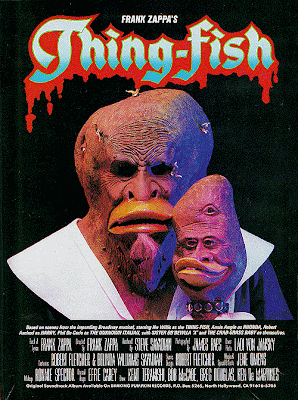
Wait, why are you running away?!
Funny enough, this is the other album besides Lumpy Gravy that Frank seemed to cherish. It's also (EASILY) the most divisive entry in his canon. Many hate it, some are merely indifferent, and a tiny lunatic fringe (including this guy) swear by it.

Final Exam:
These are the most difficult and/or uneven of releases. Zappa's work is so huge that every album has its defenders - like the one weirdo James Bond fan who claims Roger Moore is his favorite. Again, sorted by category.
In The (Cold, Sterile) Studio In The (Cold, Sterile) 1980's:
The Man From Utopia (1983)
Them Or Us (1984)
Something about these two albums make them "just kinda there;" although they both have their moments, the bad production and the lapses into humor that I think is just Frank being gross because he can outweighs the peaks. See my review of Ship Arriving Too Late To Save A Drowning Witch for why it isn't in this category.
Thing-Fish, too, has been critiqued for sounding clinical, but that's not entirely fair. Much of it is (deliberately) recycled versions of old backing tracks - like a Broadway revue - with any new songs being done on the Synclavier. Part of FZ Meets The Mothers Of Prevention falls into this category, too, but the songs in question ("We're Turning Again," "Yo Cats") make up for the mediocre production with potent - and funny - lyrics.
Live:
Baby Snakes (1983)
Does Humor Belong In Music? (1986)
You Can't Do That On Stage Anymore, Volume 1 (1988)
You Can't Do That On Stage Anymore, Volume 3 (1989)
You Can't Do That On Stage Anymore, Volume 4 (1991)
You Can't Do That On Stage Anymore, Volume 5 (1992)
You Can't Do That On Stage Anymore, Volume 6 (1992)
Those first two albums listed are reasons I'm glad most Zappa fans are happy to share their music. No one should have to pay more than ten dollars for either release. Baby Snakes is a rip-off of a live document, featuring the studio version of the title track plus a measly 30-something minutes of music from the two and a half hour long movie. Anyone else I'd say, "Oh, okay, cool, a live album!" but this is a guy who wanted to release a 12-LP set in 1969 and wanted a 4-LP set in 1977. Excuse me, Frank, but I think we could have handled a double or even triple album.
Does Humor Belong In Music? is from a night with the 1984 band, an ensemble much reviled by this author. Other fans seem to think the '84 band has simply been overexposed.
And why's that? Because a lot of the You Can't Do That On Stage Anymore series seems to be devoted to showing their crisp, picture-perfect renditions of complex pieces and breakneck-fast treatments of songs for casual listeners more than any other incarnation. Between Guitar and the YCDTOSA series (with Volume 2 solely from 1974 and Volume 5 consisting of works from 1965-1969 and 1982), I count 67 songs that were recorded and included.
All while several touring lineups went almost completely ignored, including his 1972 big band, The Mothers' final tour in late 1975/early 1976, and Zappa's first solo tour in 1976. It's a shame.
On the upside, Volume 2 is a complete concert of the Roxy-era band at their performing peak. The fifth volume consists of one disc of early Mothers recordings, including some studio outtakes (I guess you can't really do those on stage, can you?) that are all worthwhile.
One would think Frank would have given equal time to all lineups, or at least made it a little less '84-centric. Still, these packages were 2-CD's...and there were six released, in some weird way fulfilling the plans Frank had in 1969 with the 12-LP set he'd planned called The History And Collected Improvisations Of The Mothers.
The Guitar Albums:
Shut Up 'N' Play Yer Guitar (1981)
Shut Up 'N' Play Yer Guitar Some More (1981)
Return Of The Son Of Shut Up 'N' Play Yer Guitar (1981)
Guitar (1988)
Two questions:
1.) Do you like Frank Zappa's soloing styles?
2.) Are you yourself a guitarist?
If you answered yes to both of these, you are within all your rights to buy this albums once you have We're Only In It For The Money.
I like them all right, but I don't think I've ever listened to Guitar end-to-end. The three SUNPYG albums are actually pretty listenable, though some pieces (like his electric bouzouki duet with Jean-Luc Ponty on violin, "Canard Du Jour") stick out more than, say, the three title cuts, which are all different solos from the same song ("Inca Roads") from different nights. It's the sort of thing you might find yourself excited about as a guitarist...I think?
Extra Credit:
From this point on, strictly optional.
Beat The Boots:
These were two different volumes of bootlegs given an official release on Rhino Records with Frank's blessing. Even though Frank (allegedly) had these shows in soundboard-quality mixes in his vault, he sanctioned only the release of the bootleg tapes. As a result, some recordings are LP-quality, and others are almost unlistenable.
That said, Volume One (1991) of Beat The Boots was released as a boxed set and also as individual CD's. Volume Two was a boxed set only, making it a pretty nice collector's item. In a slightly cruel twist, Volume Two (1992) contains the best of the bootlegs, in terms of performance quality, historical importance, and sheer sonic fidelity. Makes me wonder if Uncle Frank did this on purpose.
Beat The Boots, Volume One:
As An Am (1981-1982)
The Ark (1969)
Freaks & Motherfuckers (1970) - awful sound
Unmitigated Audacity (1974) - ABYSMAL sound
Anyway The Wind Blows (1979)
'Tis The Season To Be Jelly (1967)
Piquantique (1973)
Beat The Boots, Volume Two:
Disconnected Synapses (1970) - with Jean-Luc Ponty on guest violin
Tengo Na Minchia Tanta
Electric Aunt Jemima (1968)
At The Circus (1978, two tracks from 1970)
Swiss Cheese / Fire! (1971)
Our Man In Nirvana (1968)
Conceptual Continuity (1976)
Posthumous Albums:
Aside from Civilization Phaze III, which was finished and in the can when he passed away, the canonicity of all other posthumous releases is speculative and contentious.
The only posthumous releases that I think are essential are The Lost Episodes (a collection of early stuff and outtakes, like The Beatles Anthology except good) and Have I Offended Someone?, a compilation of remixes of FZ's more controversial songs. Both were in the same boat as CPIII, projects approved, mixed, and mastered by Zappa before he shuffled off his mortal coil.
As for the rest? All bets are off. Any of them that aren't complete concerts (FZ:OZ, Buffalo, Philly '76) or Lost Episodes-lite discs of early recordings (Joe's Corsage, Joe's Xmasage, The Making Of Freak Out! Project Object, and Lumpy Money) I say caveat emptor. You could be buying some real garbage, like noisy lo-fi rehearsal tapes for the 1972 big band tour (Joe's Domage) or some head-scratching odds 'n sods collection of seemingly unrelated tunes (One-Shot Deal) or something of dubious origins that someone in the Zappa camp (usually either widow Gail, son Dweezil, or vault-keeper Joe Travers) swears was an unreleased project of Frank's (Trance-Fusion, which was just another guitar feature album).
That said, happy hunting and welcome to one of the most esoteric music cults this side of The Residents.
*The Eric DiBlasi Sr. grading scale is a patented system of oft-repeated phrases that I've aligned up with letter grades:
"Now, THAT was a good...(album/movie/book)" - A+
"Pretty good" - A
"It was okay" - B+
"Not bad" - B
Holding out hand and tilting it from side-to-side - C
"I didn't care for it" - D+
"Oh, MAN, that (album/movie/book)", usually accompanied by laughter - D
"I prefer not to think about the time I (heard this album/saw this movie/read this book)" - F
Friday, February 19, 2010
Frank Zappa - Ship Arriving Too Late To Save A Drowning Witch (1982)
I'm beginning to think my rating system might not be 100% accurate. I'm not just talking about the inherent biases I have - I'm well aware, thank you - but I'm wondering just how an album with less tracks will fare against something with, like an average Beatles album, maybe 14 tracks?
In all unfairness, I am selecting an artist I tend to bias in favor of, no matter what sort of guy he was in real life. In fact, the more I learn about the guy, the more I'm glad I never had an inkling of a chance to meet him - he died when I was 6 going on 7 - because we would not have gotten along. He wasn't nuts about punk music, he was a staunch pseudo-Libertarian capitalist, he ran his bands like workhorses, and his attitude from about 1980 was a painfully bitter one.
He's the reason I try to warn people to not be consumed by negativity and become cynical towards everyone and everything. Conan O'Brien was right, it is not an attractive characteristic to be had by anyone, and too much of it just as a listener and you'll find yourself falling victim to it. I can say some pretty harsh words about music, artists, and writers that I don't like, but these are rather trifling discussions about art and the various approaches to writing criticism.
Believe it or not, I am an optimist. I see the good in most things, I hope for the best, but I'm also not a blind idealist.
I'll save all that deeper material for my other blog, which is somehow even more vapid and dumb than this one.
At some point with Zappa's dense, labyrinthine catalog, you have to understand that studying each record's genesis is something best left to the experts. Considering he'd pretty much always been the boss since day one, and definitely since he disbanded the original Mothers in 1969, it's a fair assessment that Frank was a one-man unit behind all of these albums. He wrote the songs, he produced them, and after 1981 he began recording them at his own studio, the Utility Muffin Research Kitchen.
With other bands, it's not incredibly difficult to delve into artistic intent. Not really my favorite subject, either in criticism or "serious" analysis, it's made all the worse that the one guy who could explain his artistic intent has been dead since 1993. (Like he would have given his secrets away? He wasn't a fan of critics or scholars...like I said, we probably would not have gotten along. At all.)
Another thing with Zappa is that any preconceived notions you may have about live versus studio recordings needs to go out the window. He recorded (allegedly) every concert he put on since 1972, with plenty before getting taped as well. When he wanted you to hear a live album, he would let the sound of audience applause appear on the multi-track mix. When he wanted you to hear some fantastic material laid down in real time with a shit-ton of overdubs, he would mix out the audience as much as possible.
Ship Arriving Too Late To Save A Drowning Witch is a half-studio, half-live album, at least in terms of where the songs were recorded. The live side is all-new material, so the ambient sounds of the audience is pretty much mixed out. If you put the CD on in your car or have it on at a party (because people party to Zappa, right?), you might not even notice it.
Anyway, there's no linking concept. It's not an art project. It's just an album. Sometimes an album is just an album, and that is totally okay with me. It makes for a shorter review, requiring little in terms of back story and letting the songs just play out as their own pieces.
And with Zappa, whether you consider him a composer trapped in the rock world or a rock and roller with a knack for classical music, using the term "piece" instead of song is fittingly appropriate.
TRACK LISTING:
01. No Not Now [8]
02. Valley Girl [10]
03. I Come From Nowhere [10]
04. Drowning Witch [11]
05. Envelopes [7]
06. Teen-Age Prostitute [9]
My humble apologies that the album versions of tracks 4 and 5 could not be found on YouTube. After all, you should go out and buy CD's. In fact, make sure you're patronizing your local independent store and not some soulless big box chain. I owe so much of my musical development to 13th Floor Music in my hometown. The owner is a grade-A bad ass. He deserves your money. The douchebags at Best Buy, Borders, Sam Goody, fye, and other overpriced shit-palaces do not.
And fuck the iTunes store, too. Do the math and tell me that is smart shopping. Look me in the eye and tell me that is smart shopping. That's something for consumers, not listeners.
[Additionally, as I'm prepping a conference presentation on Zappa's 1984 masterpiece Thing-Fish, I promise I will do a straight-up review of the songs without veering off into the dangerous kitchen of esoteric analysis that is what Ben Watson calls Zappology. I think I scared enough of you away by taking a dump on Buddy Holly in my last review.]
THE SONGS:
01. No Not Now [8]
Lovely phase-shifter on the guitar here, and the barrage of falsetto vocalists are actually a welcome sound...normally, they annoy the shit out of me. I'm reminded of Tommy Mars' falsetto scat solo in the film Baby Snakes and how much I wanted to reach through the television and tell him to shut up and stick to playing. Anyway, it plods along with a surprisingly accessible melody and (even more surprisingly) danceable beat. No bizarre time shifts, no breaks while Art Barrow shows off his chops in a bad-ass bass solo...it's actually pretty normal by Zappa's standards.
That said, there's plenty to hear with headphones, including Art Barrow's wonderful bass line, a percussion chart from Ed Mann that (unlike a lot of other parts FZ wrote for tuned percussion) doesn't sound like cartoon music and instead adds a perfect counter-melody, and the tag-team vocals consisting of Bobby Martin, Tommy Mars, and Roy Estrada doing falsetto, Ike Willis' distinct and slightly gravelly voice and Ray White's soulful vocals that somehow make "String beans to Utah!" and "But I've had her sister" (respectively) sound like the coolest lines ever song, plus Frank's occasional interjections - "Shut up! You need a vacation, boy!" - making him, as usual the master of ceremonies.
Lyrically, the song is about a woman refusing to, um..."give it up" for a guy, hence the title, and the follow-up comment "...maybe later!" There's later references to the song's protagonist making a truck delivery of string beans to Utah, a not-so-subtle poke in the eye of Utah residents (and Mormons) Donny and Marie Osmond, and the woman from earlier opting instead to ride a mechanical bull instead of her trucker boyfriend's wiener. It's a love song...one Zappa described as a country/western song on PCP.
When the song mentions her riding the mechanical bull, former Mother Roy Estrada's falsetto laughter, trills, and disturbingly pleasured vocalizations crack me up. I wonder if this song is at all related to his later number, "Truck Driver Divorce." Maybe even "Baby, Take Your Teeth Out?"
The only drawback with this song is a lot gets lost unless you're listening closely. Something like "Brown Shoes Don't Make It" demands your attention because it grabs you. "No Not Now" works on a subtle level, with so much going on you could invariably thing it's a funky danceable number with some (seemingly) repetitive tags sung by The Bee Gees.
02. Valley Girl [10]
Boy howdy, when Frank wants everyone to hear his message, he can be as unsubtle as Johnny Rotten declaring himself to be the Antichrist. The song was a joint effort between Frank and his 15-year-old daughter Moon Unit. The story goes that Frank was so busy working in his basement studio that Moon slipped a note under his door saying she wanted to bond with him. Her constant imitations of her less intelligent classmates served as the inspiration for her contribution, while the music Frank creates shows that, if he really wanted to, he could have written songs that appealed to the masses. He just didn't want to.
The song was a hit - it became sort of a meme in its time. Inevitably, it spiraled into something ridiculous, with the Valley Girl coloring book and even a movie (that no one named Zappa had anything to do with, although it did star Elizabeth Daily, who I know best as Dottie from Pee-Wee's Big Adventure). Some Zappa fans - the very topic of Zappa fans is worthy of an anthropological dissertation - seem to disown anything the man did that people outside of the standard FZ niche of freaks and geeks enjoyed.
Whatever, let them be killjoys in their own little worlds. This only goes to enhance my argument that you should listen to whatever you want. If you found out your archenemy listened to the same music as you, does that mean you should stop listening to that music? I sure hope not. That's just stupid.
I think "Valley Girl" is still funny, even when separated from my two-month whirlwind romance with an over-privileged chick from the region in question. She didn't sound like Moon in the song, but she would occasionally bring up some bizarre subjects in a casual manner, as if it was normal that her college-aged male friend had to have a glass of warm milk before bed every single night or he couldn't sleep, stories about finding her dad's weed...lots of fun stuff that would have been a gas to explain to our kids about why Granddad smells like Venice Beach.
I digress. The song is hilarious, even on repeated listening, I happen to really enjoy the music - I know FZ was doing a send-up of New Wave music, which he wasn't nuts about, but whatever, I consider his opinions post-1980 to be misinformed and arrogant - and while the dialects might be different today, we can think of the obnoxious sorority chick on the bus telling her mom to shut the fuck up over the phone, those rotten little brats on Jersey Shore, even little charmers like Paris Hilton and hum to ourselves, "Valley Girl, she's a Valley Girl..."
They don't even need to be from the Valley.
03. I Come From Nowhere [10]
Closing out Side A is a considerably less normal piece, featuring Estrada again on lead vocals (given his appearances on this album and Jimmy Carl Black coming back for some material on You Are What You Is, one has to wonder how the Hell Frank was able to make that happen). Plenty of complex little runs in the intro, but when that riff/groove comes in at 0:18, I want to get up and dance.
Then Roy starts singing...I can almost picture this being music performed by a pop singer from another planet. Anyway, it's a delightfully bizarre delivery. The lyrics are about "Nowhere" being a land of people who mindlessly smile...perhaps a commentary on there being a pill for everything?
Where a traditional song would end, in this example, this is where Steve Vai takes over, wasting no time in showing why he is credited with "Impossible Guitar Parts" in the sleeve. Great solo...and one Hell of a song.
Later projects to come out of the UMRK would sound cold and sterile, but on these studio numbers only the drums have the punchiness that could only be achieved in a digital studio from the 1980's. At least it wasn't that God-awful gated drum sound that made the 80's a bad time to be a drummer.
04. Drowning Witch [11]
This song is a massively insane construction, and a testament not only to Frank's skills as a composer - for me, Sleep Dirt and Orchestral Favorites are all you need to convert nonbelievers - but to how incredibly tight his bands could play. Much of this song plays out like a composition, although the brief lyrics about how even witches deserve a better place to die than "America's spew-infested waterways" showed that Zappa cared about the environment.
Ecology-rock, now that would be an interesting genre.
As a twelve-minute long piece, this song is in constant flux, while all carrying an aural tone that is incredibly suggestive of being underwater. Next time I'm in my bathysphere I'll have to remember to listen to this album on my iPod. The whole band stars throughout, as Frank and Steve Vai turn in some gorgeous guitar solos (I'm not much of a guitarist to be able to tell you which solo belongs to which player, all I know is they sound great), Scott Thunes adding some great pulse on bass, especially from 2:10 to the 3:15 mark, the synths of Tommy Mars and Bobby Martin add ambiance - don't miss that SICK arpeggiated run they do right before the song's end at 11:40, and the percussion section of Ed Mann (who I contend steals the show) on tuned percussion and Chad Wackerman on drums, playing better than he ever would on later FZ releases - in my opinion. Then again, he was filling some mighty shoes, and as one of my Zappa buddies pointed out, who knows what sort of feel FZ asked Chad to play? Maybe he wanted him to keep it relatively simple.
Ed Mann gets the MVP award. Either he is part octopus or just one incredibly talented musician. Since we are living in the real world and not a comic book, I'll assume it's the latter.
Zappa, with his typical affection for his band, was quick to point out how many splices he had to make, as in his opinion the band "never got it right" in real time, so he'd piece together different performances of the same song from different nights on the road to make a definitive version.
This one clinches the 11, and not just for the magnitude of its construction or the performances. That helps, sure, but it's the end result that matters. It is a lot more than a band flexing their muscles for the audience - it sounds great.
05. Envelopes [7]
Side B all segues into one another. This song is one Frank would do again, but with an orchestra. It's fun comparing the two, but it sounds so much cooler with the band. It's another example of Zappa the composer at his best: a beautiful melody that even non-musicians can enjoy amidst a "statistically dense" backdrop.
I'm deducting some points because of several factors. To start, I don't think the song is balanced all that well. The bass is almost completely absent, and the synthesizers sound like they are sitting in your ear canal as they play while the rest of the band is up on stage. Additionally, while I like hearing someone's synth emulating a harpsichord, I don't really dig hearing (what I'm guessing is) Tommy Mars' synthesizers attempting to duplicate the sounds of brass instruments. It just sounds shitty. I don't even think modern synthesizers are capable of doing it with all the inflection and intonation a real player could bring to the table.
This almost seems like a deviation, a pause from the two songs that sandwich it. I still like it, but I don't see it making its way onto a mix CD anytime soon.
06. Teen-Age Prostitute [9]
Then there's this manic ditty, flying by like scenery on the Interstate. It's chaotic, yet finely structured, with a memorable soprano vocal appearance by Lisa Popeil.
This song was the b-side of the "Valley Girl" single. First of all, imagine all the kids who bought the 45 and, just out of curiosity, gave this one a spin. Second, it's a fitting flip-side, representing a girl on the opposite end of the economic spectrum as the Valley Girl. While the airhead from Encino is a homophobic, shallow little wench, the portrait of the Teen-Age Prostitute is a sad one: a girl who ran away from an apathetic father to help her penniless mother, now living with an abusive pimp who keeps her loaded on drugs as she walks the streets at night. It isn't a fun read.
The soprano vocals make the song comical, taking the edge off the lyrics, and the musical interludes are deftly executed. One flaw comes with this humorous presentation: we have to wonder how the composer feels about the song's subject? Is he sympathetic towards her, or is she an object of ridicule, responsible for her own circumstances? It's unclear...and given that his oldest daughter was two years younger than this song's titular figure, that doesn't sit well with me.
Still, what a way to end an album.
Subtotal: 90.0% A-
Replayability Factor: 2
There's too much going on for you to just have this one on as background music, especially with "No Not Now" and "Drowning Witch." Excellent driving music, though, just keep the A/C on low and your windows rolled up.
Consistency Factor: 1
The studio side seems to pick up where You Are What You Is left off, although "I Come From Nowhere" is a warped little delight masquerading as a pop song. Similarly, the live material carries on what Uncle Frankie started with songs like "The Black Page" on Zappa In New York, songs that are chock full of passages that I'm sure look downright terrifying on sheet music but are pleasing to the ear. In short, this one just falls short of being part of the core Zappa releases.
It's worth picking up...eventually.
External Factors: -1
This is rough. It's too short, a paltry 34 minutes in length, right after a stream of albums from 1978 to 1981 that was tightly packed: the double album Zappa In New York in March 1978, Studio Tan in September, Sleep Dirt in January 1979, the double album Sheik Yerbouti in March, Orchestral Favorites in May, Joe's Garage Act I in September, the double album Joe's Garage Acts II & III in November, the double album Tinsel Town Rebellion in May 1981, a triple-LP mail order set called Shut Up 'N Play Yer Guitar, and the double album You Are What You Is in September.
Mind you, all of this stuff came out while Zappa was battling Warner Brothers in court, shooting and editing his concert film Baby Snakes, recording, and touring. He was a busy man...I can't help but imagine this album seeming so inconsequential, only six songs (sure, they're mostly long, but still).
While Zappa's seamless editing on "Drowning Witch" is a feat, his own growing frustrations with his band - and shortly after this album, the London Symphony Orchestra - would prompt him to cut out the human element altogether and realize his compositions on the Synclavier. I don't hate his Synclavier albums, though some FZ fans swear at them and others swear by them, but his proclamation that if he had a Synclavier in the 1960's he never would have had a band is a pretty heavy insult to his own former bandmates and to musicians everywhere. It also showed Zappa as a callous asshole who didn't seem to play well with others, eager on being his own boss to a career-altering fault.
Total: 92.0% A-
I will admit, this sounds like an appropriate score for Ship Arriving Too Late To Save A Drowning Witch.
My rating system actually works...or at the very least, I want it to work so I make it work. Whatever. I'm glad I did this just to make sure. Next time I might just have to test out a double album, see how that pans out.
Any suggestions?
Tuesday, June 23, 2009
The Mothers Of Invention - One Size Fits All (1975)
With this being the final studio album released by The Mothers - whether they knew it or not - leader/songwriter Frank Zappa pulled out all the stops to make not only one of the best albums of his enormous catalog (55 by the time he passed away in 1993; his posthumous releases thrown in makes it 84 and counting...), but one of the best albums of the 1970's.
In spite of his prowess as a composer, performer, and singer, oddly enough Zappa was never able to sing and play guitar at the same time. As this album features what I consider to be his breakout as a guitar hero*, he is reliant largely on keyboardist George Duke and sax/flute man Napoleon Murphy Brock - with a cameo by Zappa's idol, Johnny "Guitar" Watson on two tracks - to handle the vocal duties. George and Napoleon have great, distinct voices, both of them setting the precedent of Frank featuring African-American musicians in his band in prominent roles.** (This may sound like something Michael Scott on The Office would point out, but it really was rare in the 1970's that a band would be integrated. It still sort of is.)
This lineup of the band - known as "The Roxy Band" due to their outstanding performance(s) on the live Roxy & Elsewhere double LP from 1974 - fit together perfectly as a tight sextet of Frank on guitar, Duke, Brock, Tom Fowler on bass, Chester Thompson (later of Genesis) on drums, and the incomparable Ruth Underwood on percussion. I love Roxy, but having a band with two drummers, trumpet, trombone, an extra synth player, and a second-string guitarist - shades of the bloating of the original Mothers' lineup - is too much to take on the road without bleeding money.
Frank did his best to showcase the talent of these musicians, all from conservatory and/or jazz backgrounds, often writing compositions of extraordinary difficulty in rhythmic or melodic structure just to see if they can do it. In the best of these examples - "T'Mershi Duween," "Don't You Ever Wash That Thing"*** - Zappa and company pound out a gorgeous melody and make it seem pretty damn easy to play. At worst - "Kung Fu" off The Lost Episodes immediately comes to mind - it's well-performed, but tricky to get into. You can't whistle it.
Zappa checks that material in at the door, and while there are some intricate passages here and there, this is a very accessible, catchy, and solid album. At times rocking, at times beautiful. However, Zappa's band lineup changed with (almost) every single album he put out. By the time the album was ready (Zappa's liner notes in the original LP are dated "Easter 1975"), he was on tour with The Mothers once again, but with Ruth gone, Chester replaced with a young Terry Bozzio (his most manic, aggressive drummer), and he'd reunited with his on-again, off-again friend Captain Beefheart. By the time the album came out, that tour was already over.
Each of Zappa's albums, I could argue moreso than any other artist, represent a specific point in time. The band you hear on Freak Out! (1966) is added to and subtracted from by the time of Absolutely Free (1967), giving each album its own distinct flavor. For me, this appeal (and his endurance) is what makes the music of Frank Zappa so great. Didn't like this album? Fine, here's another! Didn't like those - more of a classical fan? Jazz? It's all there.
Few other albums capture such a great, specific point in time as deftly as One Size Fits All. This is a band that loved a challenge, under the watchful eye (and mustache) of a man who loved to challenge his musicians.
01. Inca Roads [11]
This is iconic Zappa. The band is operating on all cylinders with one of his best album-opening tracks (again, given the breadth of his catalog, this is a distinct honor). Maybe now would be a good time to point out that lyrics aren't always as important in FZ's songs as, say, his political stuff or his critiques on society. George Duke, who by his own admission was not a singer before he joined The Mothers, gives a great performance, even if the lyrics are about aliens visiting the Incas. Whatever - it sounds fantastic. Great guitar solo. The audio you hear on the record is from the above-linked video, except for the solo, which was extracted from another live performance from Helsinki. (Yes, they were that tight that they could nail the same song at the same tempo, night after night.) I'm so glad this video exists, otherwise you'd be led to believe both Chester and Ruth - especially Ruth - had eight arms each. One of Zappa's greatest songs, and certainly one of his defining tunes from the 1970's.
02. Can't Afford No Shoes [9]
A rollicking number, with tight harmonies between Frank, Duke, and Brock. It's way too short for my liking - there is some beauty bubbling underneath the surface in those harmonies on the chorus. Great guitar solo, as well.
03. Sofa #1 [10]
A beautiful waltzing instrumental, with some neat effected bass by Tom. Duke uses an otherwordly synth voice to provide an ethereal atmosphere. There's some good drum runs by Chester near the end as the song climaxes. This song will return again at the end of the album, though the sung melody on that one can be heard here on the piano. It says something that Frank did this song on the In New York album, saying in the liner notes that no one bought the original record and wanted to give it another go. That's Zappa's way of saying he really liked it.
04. Po-Jama People [6]
There is something about this one that I've just never liked. Zappa unveils what would become a staple of his later records, where he sings really close into the microphone - you can almost hear the spit - but it's not that I don't like. I have always thought the lyrics were a little dumb, breaking down society into different types of pajamas. Given his previous assertion on Burnt Weeny Sandwich (1970) that "Everyone in this room is wearing a uniform, and don't kid yourself," it's a bit daft for him to say everyone else is a po-jama person, who are in turn boring him to pieces. The solo is great, though.
05. Florentine Pogen [10]
Opening side B, this is Napoleon's moment in the spotlight on vocals. For all of George's soul, Napoleon has an equally unique, slightly gravelly, slightly smooth voice. He had ripped it up on "Cheepnis" off Roxy the year before, and he does just as great of a job here. It's slower, but the decreased tempo gives the song a chance to be heavier. Chester's fills throughout are spot on, as are those insanely fast bits Ruth plays on her assorted instruments. Seeing it on video, I was amazed to see that the sound at 0:47 is not a flute but in fact Napoleon's own voice. I'm also pleased to report that while he isn't singing he is dancing his ass off, without once ever sounding out of breath. When it was originally recorded, "Florentine Pogen" went on for another four minutes - it can be seen/heard on The Dub Room Special! DVD/CD, thankfully.
06. Evelyn, A Modified Dog [7.5]
Even at his silliest - as on this tune - Zappa still has something up his sleeve. The references to "pan-chromatic resonance" from the voices within a piano is a nod to his 1967/1968 avant-classical masterpiece, Lumpy Gravy, which featured an orchestra, some stray rock fragments, and dialog recorded from within the inside of a piano, with the sustain pedal anchored down. Otherwise, it's a build-up to a bit of Zappaesque absurdism, like a "shaggy dog story" (no pun intended), where all this description of a dog and its surroundings climaxes with...
"Arf, she said."
07. San Ber'dino [10]
The segue is perfect, as The Mothers rock and roll their way through a bit of autobiographical information - though with Zappa's sense of the bizarre, making it just off-kilter enough that the uninitiated^ won't get it - before an extended coda with the great Johnny "Guitar" Watson on what Frank credits as "Flambe Vocals." It would seem overlong if it weren't done so well. This was the one - and sadly only - song from this album to be included on Rykodisc's 1995 compilation Strictly Commercial. Normally, I'm not one for compilations, but in the case of someone whose discography stares at you like a ziggurat, it's almost necessary, especially growing up in a town where the five people who have actually heard of Zappa know him as little more than the writer of "Don't Eat The Yellow Snow" or "Valley Girl." The harmonica is credited to one "Bloodshot Rollin' Red," a pseudonym for the man behind my favorite pseudonymous rockstar, Captain Beefheart. I would have loved to have seen the sessions for this number.
08. Andy [10]
Johnny features again, this time more prominently. A book came out a few years back by a groupie-turned-musician named Nigey Lennon. She and Frank had (by all other accounts) a brief fling, but her book stretched it out to span the first half of the 1970's. I'm not so sure about that, but I don't dismiss her claim. I also won't completely rule out that the lyrics - "Is there anything good inside of you? / If there is I really wanna know!" - are about her. Anyway, this song modulates and shifts as many times as The Who's "A Quick One, While He's Away" in less time, starting off as a funky march, a creepy sort of whispered segment, gutbucket R&B, a catchy chorus, an instrumental passage with some sci-fi organ, Duke singing over something that could pass as disco in some circuits, before building up to the final chorus (a different one), brought full circle by Watson. A fantastic musical tour de force.
09. Sofa #2 [10]
The cool late-night majesty of "Sofa #1" is revisited with lyrics, with Duke singing the verses, and Zappa (later with others) doing the response - in German. There is a history to this song, dating back to the second incarnation of The Mothers from 1970-1971. "Sofa" was part of a suite of several songs. This one and "Stick It Out" (off 1979's Joe's Garage Acts II And III) saw a reworking and proper release. The rest stayed in the can. I wasn't that fond of the suite when I heard it, but it's still really cool to know that Zappa could, at any given point, whip out a song several years old and have it be completely new for most of the audience. A good closer for a terrific album.
Subtotal: 92.78%
Replayability Factor: +3
Not every Zappa album is this palatable. In fact, I could say "Zappa" and "palatable" are words that don't belong together all that often. This makes for one well-crafted exception.
Consistency Factor: +3
One Size Fits All stands as one of a few Zappa albums I could recommend as a "first purchase" for a curious fan - and if you call yourself a fan and don't own this album you are not a fan! (It's one of those.)
External Factors: +2
The arrangements are great, George and Napoleon are such good singers - and J.G. Watson is a welcome surprise, and the band itself is tight. It isn't marred by the dreaded sounds of the 1980's that loomed ahead, it doesn't sound too thin or too thick, and the ability for Frank to use live pieces and make them sound like studio-quality recordings is no small feat, either.
FINAL SCORE: 100.8% A+
* For the Zappa geeks, yes, I acknowledge and adore Frank's earlier guitar work on "Stuff Up The Cracks," "Theme From Burnt Weeny Sandwich," "Holiday In Berlin, Full-Blown," "Willie The Pimp," "My Guitar Wants To Kill Your Mama," etc. But what gives One Size Fits All the status as his "breakout" as a guitar man is that nearly every song allows for a solo from Frank.
** Though Don "Sugarcane" Harris enjoyed some spots with The Mothers and Frank's short-lived Hot Rats band, it really started with Duke and Brock, followed in the late 70's and throughout the 80's with Ray White and the ever-present Ike Willis.
*** In spite of the seemingly off-putting song title(s), bear in mind Zappa had a knack for giving his instrumental compositions silly or just plain crude names. See also: "I Promise Not To Come In Your Mouth," "G-Spot Tornado," "Alien Orifice." All sublime tunes...just don't leave these albums out when the grandparents come over. (Voice of experience, people.)
^ I say "uninitiated" with a bit of contempt, having had more than my share of run-ins with people who have taken the Zappa class at IU or just pretend to be fans when all they've got is a best of and a fairly predictable handful. They'll like a song, but have no idea what it's about. There's no way around this without being a dick, but owning 10% of someone's recorded output isn't fandom. With Zappa, this is something to dive into. Head first.
Subscribe to:
Posts (Atom)